
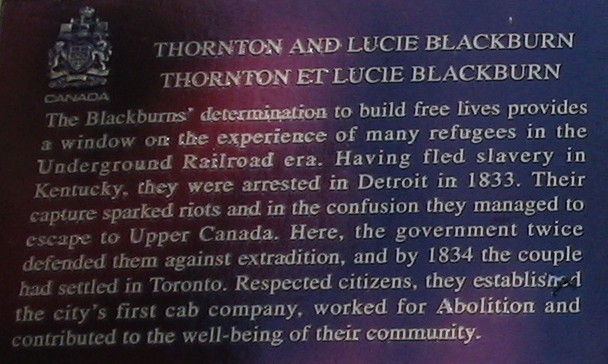
Thornton Blackburn was born into slavery in Maysville, Kentucky in 1812. While enslaved, he met and married Lucie. When they learned that Lucie was to be auctioned off, they escaped. Carrying forged papers identifying them as free African Americans, the couple travelled north by steamboat, then by stagecoach, ending up in Detroit.
Unfortunately, Thornton was recognized in Detroit and the couple were arrested and tried under US federal law as “fugitive slaves”. This resulted in unrest and riots erupted. Through the confusion both Lucie and Thornton were rescued and escaped to the Canadian side of the Detroit River. The riots that ensued were called the Blackburn Riots of 1833.
Accusing them of inciting civil unrest, the acting Governor of Michigan demanded the Blackburns’ extradition. In his review, the Attorney General determined that if the couple was returned to the US they would be returned to slavery. Considering that enslavement was not a punishment imposed in British colonial Canada, the Blackburns could not be returned to face a sentence harsher than what would be allowed in Canada. The extradition was denied. The principle of this decision continues to be the foundation of our current extradition laws.
The Blackburns moved to Toronto, where they started Toronto’s first taxi cab company. The colours of their single cab continue to be reflected in the TTC red and yellow logo colours of today.
The Blackburns were very active in the underground railway, billeting many newly arrived freedom seekers. Their successful taxi business also allowed them to purchase a number of homes which they rented to those newly arrived. As an abolitionist, Thornton was also involved in the building of a sawmill, flourmill and general store to provide jobs to the new community of formally enslaved people in Buxton, in what is now south-west Ontario.
In 1985 the foundations of the Thornton’s small home, barn and root cellar were unearthed in a school yard in downtown Toronto. More than 3000 schoolchildren and volunteers took part in the excavation and received worldwide media coverage. The above plaque sits at the home site at 19 Sackville St, Toronto.