
“Mob rule cannot be allowed to override the decisions of our courts.” President Dwight D. Eisenhower’s 1957 Address on Little Rock, Arkansas.
In 1957, Little Rock Central High School was the epicenter of confrontation and a catalyst for change as the fundamental test for the United States to enforce African American civil rights following Brown v. Board of Education. The sacrifice and struggle endured by the Little Rock Nine have provided opportunities and opened doors for those seeking equality and education around the world.
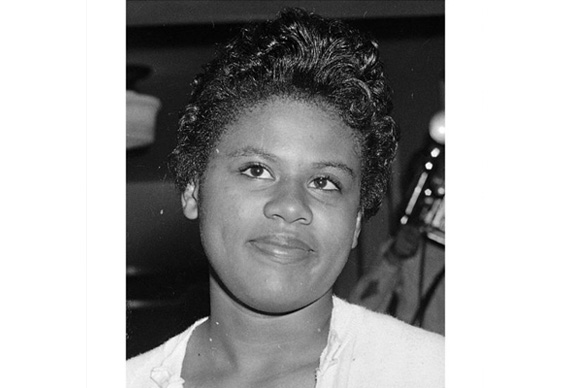
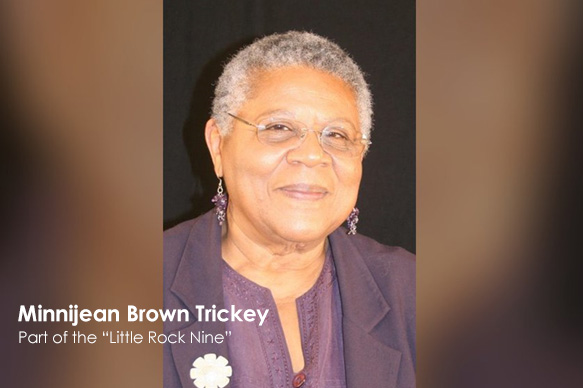
Minnijean Brown Trickey was only fifteen years old when she gained her place in American history. On September 25, 1957 the epitome of heroism happened when Minnijean Brown – Trickey as part of the “Little Rock Nine”, a group of nine young African –American students desegregated the public school system. The students originally attempted to enter the school on September 4, 1957, but were stopped by the Arkansas National Guard called in by Governor Orval Faubus. In response, President Dwight D. Eisenhower sent 1,200 U.S. paratroopers from the 101st Airborne Division to assist the Little Rock Nine in entering the school. Despite the troops being stationed at the high school throughout the ’57-’58 school year, the nine students were physically and verbally harassed by their classmates. Her response to the planned and constant harassment resulted in her being expelled. She completed her high school education in Manhattan New York.
Brown attended Southern Illinois University where she majored in journalism in 1967. She lived in Canada for a number of years in the 1980s and 1990s, where she studied social work at Laurentian University in Sudbury, Ontario, and later completing a Master of Social Work degree at Carleton University in Ottawa, Ontario. She moved back to America and worked for the Clinton Administration in 1999 through 2001 as the Deputy Assistant Secretary for Workforce Diversity at the Department of the Interior . Presently living in Canada she has been involved in First Nations activism and received many awards for her work. A documentary film entitled Journey to Little Rock: Story of Minnijean Brown Trickey (2002) was produced in Ottawa, where Brown –Trickey lived during the 1990s.
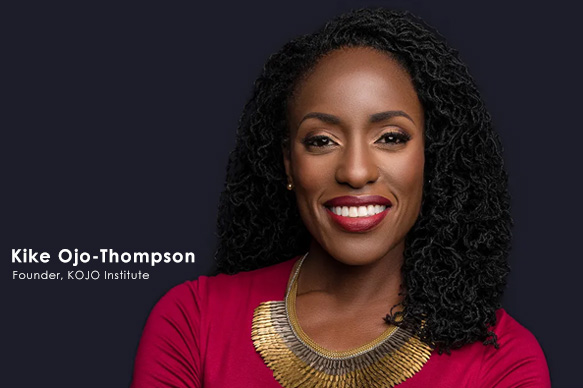
Kike Ojo-Thompson (pronounced Kee-Keh Oh-Joe Thompson) is an expert on equity and the founder and principal consultant of KOJO Institute. Over the last 20 years she has introduced and implemented equity anti-oppression and anti-racism frameworks and practice into dozens of organizations. She has worked in a broad range of sectors including education, child welfare, healthcare, law enforcement and criminal justice, media and culture. Ojo- Thompson has an unwavering commitment to providing effective solutions to systemic oppression and inequity.
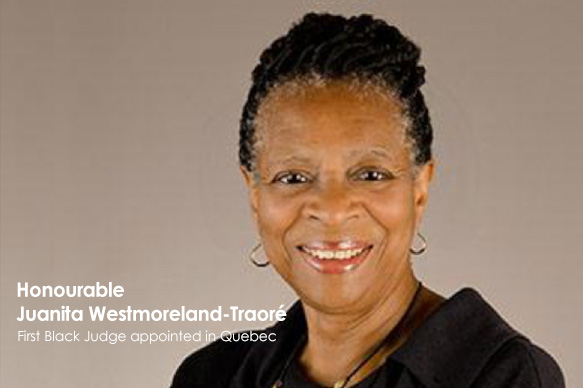
Hon. Juanita Westmoreland-Traoré
She is the first black judge to be appointed to the courts in the history of Quebec. She also holds the distinction of being the first Black Dean of a law school in Canada. She was the Dean at the University of Windsor Faculty of Law from 1996 to 1999.She stands as a symbol of great individual achievement and an inspiration for others to emulate.

The most Honourable Portia Lucretia Simpson-Miller was Jamaica’s first female Prime Minister (PM) She was sworn in during 2012. Her ascension to Jamaica’s highest office came after serving 17 years as a cabinet minister. She has a distinguished record of service at the regional and international level. She previously served as the PM from March 2006 to September 2007. In 2011, as Leader of the PNP she returned to government for a second time. By doing so she became the second individual to have served non-consecutive terms as PM in Jamaican History.